My recent post about Alex Epstein and the moral case for fossil fuels told only part of his story. He also says that the global warming “alarmists” have it all wrong. He refers to “unambiguous” data that CO2 emissions have risen from an atmosphere concentration of .03% to .04%, while over the same period climate-related deaths have declined 98%, and drought-related deaths have declined by 99.8%.

Here are some of Alex’s other points:

  • Defenders of fossil fuels, when they publicly endorse “renewable” as the ideal, defeat themselves by essentially agreeing that there is a moral case against fossil fuels.
  • The implication is that “renewables” are the goal and oil and gas is just a temporary necessary evil.
  • Once greenhouse gas emissions are endorsed as a fundamental benchmark of environmental health, the industry is conceding that it is causing catastrophic global warming and that reducing greenhouse gas emissions is moral imperative.

What’s With Honey Boo Boo and Fossil Fuels?

Which leads me to a related topic. In preparing this blog I see more blog posts and news articles than you can imagine about “global warming”, “climate change” and the like.  I’ve concluded that the issue is so highly politicized, has attracted so many advocacy groups, and has generated so many puroprtedly scientific opinions on one side or the other that I (not being an engineer) don’t know what to believe.

Thus, for the time being I leave it to you to Google “global warming” or “climate change” and decide for yourself. In the meantime here are a few sources I’ve come across that you can rely on, at least for their consistency:

The “Alarmists”: The International Panel on Climate Change  (where it all started), Al Gore and the Huffington Post  (a twofer here), pretty much anything from the New York Times (insidious for what it elects not to print as much as for what it does), Grist (Can you get farther left?).

The “Deniers”: Non-Governmental International Panel on Climate Change ; Bjorn Lomberg (not so much a “denier” as an alternative thinker); The Foundry, from the Heritage Foundation (far right on just about everything); Powerline; Watts Up With That.

Somewhere out there are “moderates”. Rich and Elizabeth Muller might be two of them. I know they’re U C Berkeley professors. Just read what he has to say.

This GW hiatus doesn’t include the fracking controversy. (Or is it fracing, or frac’ing? I’ve been castigated by my friend, Dallas lawyer Pat Shaw, for using “fracking”. Pat says only the “anti’s” use that spelling).

Having tired of trying to figure out if the world is going to perish by 2020, or 2035, or 2100, or the next presidential election, or never, I’ve moved on to more weighty topics:

  • Noah: Blasphemy or clueless Hollywood entertainment?
  • Lord Grantham:  Anachronistic dilettante or an honorable man preserving noblesse oblige and other worthy institutions?
  • Who will win the AL West? … the SEC West?
  • Should the USA convert to the metric system?
  • Clapton or Hendrix?
  • First place in artistic achievement:  Hoarders, Cheaters, or Here Comes Honey Boo Boo?

As with GW, decide for yourself.


By: Martin P. Averill

Are general partnership agreements for oil and gas exploration considered “securities” governed by federal securities regulations?

The U.S. Court of Appeals for the 10th Circuit  thinks they could be. In SEC v. Jeffory D. Shields and Geodynamics, Inc. et al., the court reversed a trial court ruling which dismissed the SEC’s claims that general partnership agreements for oil and gas exploration were actually federal securities. The appellate court adopted a three-factor test adopted from the federal Fifth Circuit to gauge whether a general partnership interest can be a “security.” If any of those factors are met, an investor may overcome the “strong presumption” that a general partnership interest is not a security.

The Analysis

Three key factors were considered by the court:

  • The agreement between the parties leaves so little power in the partners’ hands that it essentially acts as a limited partnership;
  • The partners are so inexperienced and unknowledgeable in the particular business that they are incapable of exercising partnership or venture powers: and
  • The partners depend on unique abilities of the promoter or manager such that they cannot replace the manager or otherwise exercise meaningful partnership or venture powers.

The court found that all three factors were present.

It is important to note that this decision does not mean these investments were actually securities—the court simply ruled that the SEC’s claims were enough to overcome a motion to dismiss for failure to state a claim. The court sent the case back to the trial court for further proceedings and factual development.

Bad Facts Make Bad Law

It is also worth noting that the defendant Shields was in prison for fraud at the time the opinion was issued.  Other facts were also present. Among the most egregious:

  • Of the roughly $5 million raised from investors, only $613,494 went to oil and gas development with the rest goint to Shields directly or to his company;
  • The money was commingled with other investor funds;
  • The drilling was never finished;
  • No oil or gas was ever produced; and
  • The general partners never received any funds.

The Takeaway

Merely crafting an oil and gas investment as a general partnership interest will not automatically insulate it from scrutiny and attack under federal securities regulations. If the “general partners” effectively cannot exercise power, and are at the mercy of the manager of the venture for its expertise, or other egregious facts exist, substance may trump form and federal securities laws may apply.

The 10th Circuit hears cases from Oklahoma, Kansas, New Mexico, Colorado, Wyoming, and Utah. The 5th Circuit hears cases from Texas, Louisiana and Mississippi.

Today’s musical interlude is dedicated to the defendant/jailbird Mr. Shields


Do bystanders see oil and gas producers as taking a stand for morality?  Alex Epstein of the Center for Industrial Progress says they should.  He approaches the value of fossil fuels in our society differently from most industry defenders. The opponents make a moral case against fossil fuels: They destroy the earth and their use must be eradicated. His response is that there is a moral case in favor.

According to Alex, there is a philosophical question: An activity is moral if it is fundamentally beneficial to human life. He makes the case that the fossil fuel industry is a moral endeavor. Among his reasons:

  • Fossil fuels have made our environment safer by such efforts as producing huge amounts of fresh food (think about what fuels the farm tractor), generating heat and air conditioning (fossil fuel-generated power plants), irrigating deserts, manufacturing, and actually protecting ourselves from the climate.
  • The use of fossil fuels brought about a period of safety, longevity and prosperity that was not known to the human race before the industrial revolution.
  • Virtually everything we eat, drive, wear, live in, and use every day has been made better and more affordable by fossil fuels. (Imagine the 70’s without polyester and puka beads?)
  • Those opposed to fossil fuels view the industry as an evil that must be eradicated as soon as possible. Rather than apologize, thereby essentially agreeing that renewables are the ideal, industry supporters should be proud of the contributions fossil fuels have made to prosperity throughout the world.

As an amateur philospher, I add that you could question the morality of  dramatically raising the cost of living for everyone, especially the poor and middle class throughout the world, by the abrupt replacement of of fossil fuels, as urged by many elements of the environmental movement. 

His point is that with a little thought, defenders of the industry could do a much better job of defending. Here is his philosophy in more detail.

Co-author Travis Booher

Chesapeake Exploration, L.L.C. v. Hyder is another hair-splitting Texas decision about “cost-free royalties”

The Facts

The Hyder family executed a lease covering 1,037 acres. Chesapeake drilled 22 wells on the leased premises. The Hyders believed their lease provided for a “cost free” royalty; that is, no post-production deductions. Chesapeake deducted post-production costs, and the Hyders sued for breach of contract.

More Facts

A summary of how gas is moved downstream from the lease might be helpful (Hint: if it starts with a “C”, it’s a Chesapeake entity). COI produces the gas and sells to CEMI, who delivers the gas to several “points of delivery” for gathering by CMP. CMP transports to unaffiliated third-party interstate pipelines, who transfer the gas downstream to a “point of sale”, and then title passes from CEMI to the third-party purchaser. The Hyders were paid based on a weighted average sales price calculated on the sales to various third parties.

The Royalty Clause

The Hyders where to be paid:

…for natural gas … produced from the Leased Premises, twenty-five (25%) of the price actually received for such gas. The royalty … shall be free and clear of all production and post-production costs and expenses, including but not limited to, production, gathering, separating, storing, dehydrating, compressing, transporting, processing, treating, marketing, delivering, or any other costs and expenses incurred between the wellhead and lessee’s point of delivery or sale of such share to a third party. (underline ours)

The lease specifically said that, “ … Heritage Resources, Inc. v. NationsBank shall have no application to the terms and provisions of this lease.” (that was the 1996 Texas Supreme Court case holding that a “no deduct” provision was “surplusage as a matter of law.”)

Chesapeake’s Contention

They could deduct post-production costs incurred between the “point of delivery” and “point of sale.” Because of the disjunctive “or” between “delivery” and “sale”, they could choose either the point of delivery or the point of sale to determine whether the royalty clause permits the deduction of post-production costs after the point of delivery but before the point of sale. Therefore, they deducted costs such as third-party transportation costs.

Hyders’ Contention

Chesapeake’s distinction doesn’t matter. The royalty clause prohibits deduction of any post-production cost, regardless of where incurred, and provides for royalty “free and clear” of all costs. What about “free and clear” can’t be understood?

The Holding

The court agreed with the Hyders. The plain reading of the royalty clause, along with the parties’ agreement that Heritage did not apply, should be interpreted to mean no deductions. Therefore, in this case a “cost-free royalty” really meant a cost-free royalty.

The Takeaway

  • This is a common theme. It is necessary to carefully review the specific wording in the lease. Sometimes, “free” does mean “free”.  Sometimes it doesn’t. A court will construe a lease so that no provision will be rendered meaningless.
  • This post is about wells on the premises.  We will soon discuss the overriding royalty interest due the Hyders for seven Chesapeake off-premises wells.
  • As royalty clauses go, it looks like lessors have found a keeper.  (Or maybe you prefer the live version.)

Co-author Alexandra A. Crawley

Conventional wisdom is that a spouse’s earnings from separate property are community property. But it’s not that simple. In Benavides v. Mathis a Texas court denied wife Leticia’s claim to one-half of the income derived from minerals held in a trust in which incapacitated husband Carlos was a beneficiary.

Years before Carlos and Leticia began their nuptial journey, Carlos’ family created the Benavides Family Mineral Trust for the preservation and management of 126,000 mineral acres. Carlos was one of several participating beneficiaries who received monthly payments of revenues from the trust estate. A temporary guardian was appointed for Carlos’ person and estate in 2011. In 2012 Leticia asked the guardian to deliver to Leticia one-half of all distributions owed to Carlos because they were community property. The guardian refused and Letitica sued.

Leticia’s Arguments

• Under Texas law, income from the separate estate of one spouse is community property and therefore, the revenues from Carlos’ trust estate were community property.

• The trust was revocable because it could be amended by a decision of 3/4ths of the beneficiaries.

• Carlos had a present, possessory right because he had the right (a) to transfer his interest; (b) to receive a portion of the corpus, and (c) to receive all of his share of the corpus on termination of the trust.

The Court’s Ruling – Leticia Scorned

Income distributions to Carlos were his separate property. The court relied on precedent holding that distributions from an irrevocable trust are community property only if the recipient has a present possessory right to part of the corpus.

In rejecting Leticia’s position that the trust was revocable because it could be amended by a decision of 3/4ths of the beneficiaries the court relied on the express terms of the trust, which provided that it was “expressly irrevocable.” The court also rejected Leticia’s argument that Carlos had a present, possessory right:

• Right to transfer: Carlos’ right to transfer the property did not mean he had a present possessory interest because this right was expressly and strictly limited in the trust agreement, and any transferred interest would remain subject to the trust.

• Right to receive a portion of the corpus: Under the terms of the trust, royalties and bonuses would not become a part of the trust corpus and therefore, the fact that Carlos received royalties and bonuses as revenue did not mean he had a present possessory interest in the trust corpus.

• Right to receive all of his share of the corpus on termination of the trust: Even though Carlos’s interest will vest eventually, “this will not occur until the trust terminates, which is long after Carlos’s death.”

Takeaways

  • To its credit the court wrote a thorough and erudite opinion.  A soap opera would have made for a more entertaining reading experience. Was Leticia only in it for the money? Was the guardian a Scrooge?  What happened between the players for it to end up at the courthouse? What will happen if Carlos regains his faculties? Maybe the answer is in the briefs.
  • When in doubt about the legal effect of a trust, read the document itself and the answer will reveal itself.
  • Where a Texas trust is irrevocable, and the beneficiary does not have a present, possessory interest in the corpus, as a matter of law the distributions are separate property.

What is a wild bird worth? Does it matter whether it is a Bald or Golden Eagle, of which here are few, or ducks and pelicans, of which there are enough (as least the ducks) so that hunters may shoot them for dinner.  Does it matter how they meet their demise? Is a bird drowned in oil worth more one fried by a solar panel or chopped up into pieces by a wind turbine?  If one is determined to have no value and the other somewhere between several hundred and several thousand dollars, would you wonder how the value is calculated?  And what about bats – those environmentally friendly creatures without a lot of human admirers?

A 2012 post discussed a fine on CITGO Petroleum for violating the Migratory Bird Treaty Act. Ten migratory birds drowned in storage tanks at CITGO’s Corpus Christi refinery. The company was convicted on two felony and three misdemeanor counts.  In 2012 the court determined the fine could be as large as $2,000,900.  In a February 10, 2014 Judgment, the fine actually imposed was $1,045,000. The fine included Clean Air Act violations as well.

On the other end of the federal regulatory continuum, you have three examples of the effect of wind and solar operations on our avian friends.

We are warned of a new rule by the Department of the Interior that, in the words of the Audubon Society, makes possible 30 year permits for wind energy companies to site wind turbines in ways that kill Golden and Bald eagles.

What is reputed to be the world’s largest solar farm, the Ivanpah Solar Electric Generating System in the Mohave Desert in California, is said to be causing birds flying through the area to be scorched by the 350,000 gigantic mirrors covering an area of five square miles and which generate temperatures of 1,000 degrees Fahrenheit. Environment groups are challenging the project and complaining about its effect on wildlife. For their part, the regulators are conducting a two year study on the plant’s effect on birds.

And a study by Mark Hayes of the University of Colorado in the journal Bioscience estimates that 600,000 to 900,000 bats could be killed every year as a result of flying into wind turbines. The estimate is based on the number of dead bats actually found at 21 locations.  Bioscience is a publication of the American Institute of Biological Sciences.

Is there a coherent public policy behind this disparate treatment of energy sources? I can’t find one.

Today’s musical theme give us choices: 

If I were a bird or a bat looking for an easy way out, I might be thinking like this:

But if I were a person looking for a party, I’d remember that it’s Mardi Gras.

The question in Graham v. Prochaska: Did the grantors in a 1950 Texas warranty deed reserve a “floating” 1/2 royalty interest or a “fixed” 1/16th royalty?

The Deed

At issue were three provisions:

  • Save and except there is reserved … ½ of the 1/8th royalty to be provided in any and all leases …, same being equal to 1/16th … “.
  • Provided …” there were outstanding reservations “… each of 1/4th of 1/8th royalty …”.
  • “It being the intent of the parties that the Regmunds shall be vested with and entitled to ½ of the usual 1/8th …, and the reservation hereinabove recited in favor of the grantor shall relateroyalty  to and cover only the ½ of 1/8th royalty interest previously reserved …”.

The Analysis

The court concluded that “1/8th royalty” in the save and except clause must be read with the surrounding descriptive language and was thus modified by “the … to be provided in any and all leases …”. The use of the word “the” denotes that the 1/8th royalty is a distinct or particular royalty. Thus, the reservation reserved a floating royalty. The court declined to construe “1/8th” in the description of the landowner’s royalty as a limitation of the Prochaska’s interest to a fixed royalty.

The court construed the intent clause as intending that the Regmunds would receive half of whatever royalty there was in future leases. The court acknowledged that in another case it might construe the description differently but chose not to do so in this case.

The court construed the provided clause describing the outstanding mineral royalty reservations as potentially inconsistent, but the court chose to construe this deed by incorporating the earlier deeds and reservations and concluded that by specifically referencing the prior deeds incorporated their description into itself. Those deeds referred to a floating royalty interest.

Takeaways

  • This result cannot be squared with other cases that are discussed in the opinion. The court admitted in several places that it could have gone the other way.  That might explain the dissenting opinion.
  • If your reservation seems to be tied to a 1/8th royalty, do not despair.
  • Be wary in relying on these opinions because each is so unique.  Hire an 8th grade English teacher to parse your deed.
  • Confusion will continue in cases construing older reservations.  The parties assumed that because the typical lessor’s royalty was 1/8th it would always be that way. We now know better. The lease in existence in this litigation had a 1/5th royalty

Bonus quiz: What are the five rights owned under the “mineral estate”? See the answer on page 6 of the Opinion.

Suppose I own a large tract of land in the region of the Barnett Shale, the exclusive right to allow (or prevent) drilling on the aforesaid land, and a desparate need for funds. You have $19 million and the desire to exploit the minerals. I take your $19 million, and when you ask for permission to drill I refuse, and I don’t even offer to return your $19 million. What would you do?

As expected, we learned what Trinity East Energy, LLC would do. They’ve sued the City of Dallas for breach of contract (the lease), inverse condemnation (for taking their leasehold interest without compensation), and fraud (for representing that special use permits would come, knowing they wouldn’t) in connection with a 2008 oil and gas lease over 3,600 acres of City of Dallas land. After collecting the $19 million bonus, the city prevented Trinity from developing the lease by denying special use permits necessary to drill wells, both on the property and on land near enough to the property to exploit the minerals. The damages sought are far greater than the $19 milliion bonus.

Someone who expected this result was Mayor Rawlings, who warned the council of potential litigation in the meeting at which Trinity’s permits were denied. So would anybody who believes that, upon paying $19 million for something and then being denied the right to do anything with it by the party who took the money in the first place, most self-respecting businesses would demand to be made whole.

When trying to understand this situation, the notion of sowing and reaping comes immediately to mind. You have the sowers – the City Council and the City Plan Commission members who denied the special use permits. Then you have the reapers – that would be the same as the sowers. Often overlooked in these discussions are the unwilling reapers, otherwise known as the losers, the collateral damage if you will. As in all cases of governmental chicanery, that would be the citizens of Dallas, who can expect a large legal bill and then, potentially, a large judgment or settlement, not to mention lost revenues from production, should the wells have been successful.

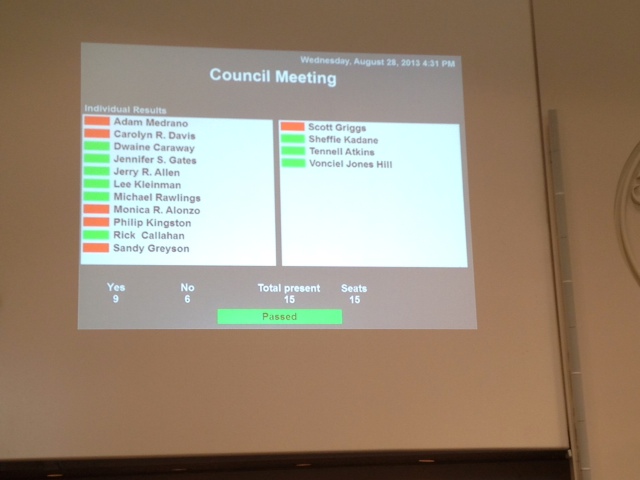
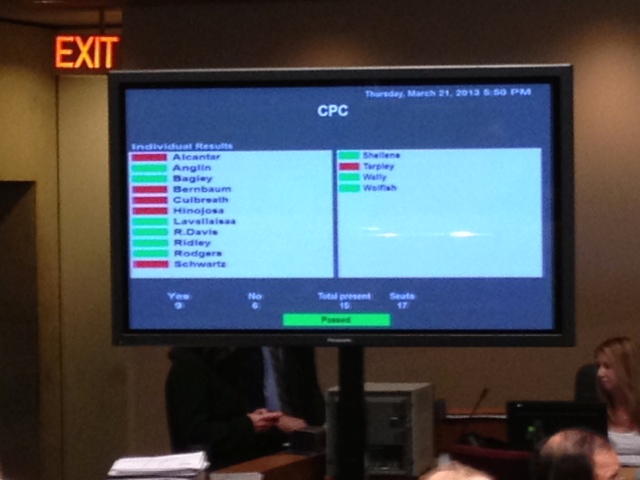
Who’s responsible for this statutory, contractual, constitutional and moral failure? Here are the votes by council and plan commission members. Ask them why they voted against. Note: The council measure didn’t “pass”. A three fourth’s vote was required because it failed at the CPC.

In the name of good government, hope it didn’t happen this way: Intimidated by the few but animated anti-fracking troglodytes (mentioned previously in this blog and other places) the commission and council members followed the politically expedient course: Deny the permits, thereby escaping the proximate wrath of the anti’s.  When the repercussions come home to roost, hope the fallout will be dispersed and the voters won’t notice. 

Here, revealed to me by insiders at city hall, is the trial strategy of the City and its lawyers.

Co-author Ann Weissmann

The Dietz family sued several lessees for injunctive relief and restorative damages arising out of leases on two non-contiguous tracts in Acadia Parish. In Dietz, et al. v. Superior Oil Company, et al  the trial court granted the lessees’ dilatory exceptions of prematurity and improper cumulation and dismissed the plaintiff’s suit without prejudice.

The family asserted that the lessees improperly used and abandoned oil field waste storage pits and exploration and production equipment, causing contamination of the soil and groundwater. The defendants filed the exceptions to avoid the suit.

Prematurity 

The defendants’ dilatory exception of prematurity asserted that they were not given notice prior to the suit as required by Mineral Code Article 136 and that the claims were premature, as the lease was still in effect.

The trial court’s grant of the prematurity exception was because the defendants had not been given written notice as required by Article 136. The appellate court found that the trial court erred in granting the prematurity exception. Claims for restoration of contamination are not governed by Mineral Code Article 136 and do not require advanced written notice as these claims “are separate and distinct from any claims that defendants failed to develop and operate the property”.

A suit for contamination of soil and groundwater may be brought before the lease expires. The lessee has obligations set out in the Mineral Code and in Civil Code Articles 2683, 2686, 2687 and 2692. Civil Code Article 2683 specifically defines the Lessee’s obligations. While Article 2683 has obligations which arise at the end of the lease, there is “absolutely no language to suggest that the other obligations imposed by these codal provisions are not operational until termination of the lease.”

Improper Cumulation

The trial court’s grant of the exception of improper cumulation was because there was a lack of community of interest between the joined parties. These exceptions were affirmed. In order to determine if there is a community of interest between the parties, the courts will look to see if the causes of action arise from the same facts and present the same legal and factual issues. Is there an overlap “present between the cases to make it commonsensical to litigate them together”? Proof of damages and liability would be different for each party. There were numerous defendants and non-contiguous lands, with each defendant having different lease obligations with different facts being proven for each operator. Therefore, there would be a lack of overlap required for a proper cumulation. The court affirmed dismissal of the suit without prejudice.

Driven to know the elements of improper cumulation? See Code of Civil Procedure Article 463.

Takeaways

I see two: 

The plaintiff-landowners lost this round but lived to fight another day.

The is no end soon to pollution claims against legacy producers in Louisiana oil fields.

In a case from Acadia Parish, how can we not pay musical tribute to J. D. Miller’s recording studio in Crowley.  Here is an example. 

The first step in successfully challenging the Keystone Pipeline: Choose a court that has jurisdiction. Mr. Bishop learned that lesson the hard way in Bishop v. TransCanada Keystone Pipeline.

Mr. Bishop lived in Nacogdoches County, Texas, when TransCanada attempted to negotiate an easement and pipeline right-of-way. Those negotiations failed and TransCanada brought a condemnation proceeding. Bishop believed TransCanada didn’t have the right of eminent domain and didn’t agree with the special commissioners assigned to the project (the process for Texas condemnation proceedings that aren’t resolved by agreement). The parties settled and executed a mediated settlement agreement.

Mr. Bishop wasn’t happy with the document, and as a pro se plaintiff (that is, without a lawyer to speak for him), filed a new suit in the County Court at Law of Nacogdoches County. He alleged in his petition that the agreements were as a result of coercion, duress and fraud. The question for the court was whether the dispute was over the ownership of land or over a breach of a contract. The significance is that as a statutory county court, the County Court at Law of Nacogdoches County does not have jurisdiction over “a suit for recovery of land.”

The real question was whether an easement involves an interest in land. In his petition Bishop requested that the court prohibit TransCanada from exercising its rights under the easement negotiated at the settlement and to rescind the easement and pipeline rights-of-way. The appellate court concluded that an easement is an interest in land and that the county court at law had no jurisdiction.  Mr. Bishop’s claims were dismissed.

Takeaway

If you are making a trip to the courthouse, bring along a lawyer.