Co-author Alexandra A. Crawley

Conventional wisdom is that a spouse’s earnings from separate property are community property. But it’s not that simple. In Benavides v. Mathis a Texas court denied wife Leticia’s claim to one-half of the income derived from minerals held in a trust in which incapacitated husband Carlos was a beneficiary.

Years before Carlos and Leticia began their nuptial journey, Carlos’ family created the Benavides Family Mineral Trust for the preservation and management of 126,000 mineral acres. Carlos was one of several participating beneficiaries who received monthly payments of revenues from the trust estate. A temporary guardian was appointed for Carlos’ person and estate in 2011. In 2012 Leticia asked the guardian to deliver to Leticia one-half of all distributions owed to Carlos because they were community property. The guardian refused and Letitica sued.

Leticia’s Arguments

• Under Texas law, income from the separate estate of one spouse is community property and therefore, the revenues from Carlos’ trust estate were community property.

• The trust was revocable because it could be amended by a decision of 3/4ths of the beneficiaries.

• Carlos had a present, possessory right because he had the right (a) to transfer his interest; (b) to receive a portion of the corpus, and (c) to receive all of his share of the corpus on termination of the trust.

The Court’s Ruling – Leticia Scorned

Income distributions to Carlos were his separate property. The court relied on precedent holding that distributions from an irrevocable trust are community property only if the recipient has a present possessory right to part of the corpus.

In rejecting Leticia’s position that the trust was revocable because it could be amended by a decision of 3/4ths of the beneficiaries the court relied on the express terms of the trust, which provided that it was “expressly irrevocable.” The court also rejected Leticia’s argument that Carlos had a present, possessory right:

• Right to transfer: Carlos’ right to transfer the property did not mean he had a present possessory interest because this right was expressly and strictly limited in the trust agreement, and any transferred interest would remain subject to the trust.

• Right to receive a portion of the corpus: Under the terms of the trust, royalties and bonuses would not become a part of the trust corpus and therefore, the fact that Carlos received royalties and bonuses as revenue did not mean he had a present possessory interest in the trust corpus.

• Right to receive all of his share of the corpus on termination of the trust: Even though Carlos’s interest will vest eventually, “this will not occur until the trust terminates, which is long after Carlos’s death.”

Takeaways

  • To its credit the court wrote a thorough and erudite opinion.  A soap opera would have made for a more entertaining reading experience. Was Leticia only in it for the money? Was the guardian a Scrooge?  What happened between the players for it to end up at the courthouse? What will happen if Carlos regains his faculties? Maybe the answer is in the briefs.
  • When in doubt about the legal effect of a trust, read the document itself and the answer will reveal itself.
  • Where a Texas trust is irrevocable, and the beneficiary does not have a present, possessory interest in the corpus, as a matter of law the distributions are separate property.

What is a wild bird worth? Does it matter whether it is a Bald or Golden Eagle, of which here are few, or ducks and pelicans, of which there are enough (as least the ducks) so that hunters may shoot them for dinner.  Does it matter how they meet their demise? Is a bird drowned in oil worth more one fried by a solar panel or chopped up into pieces by a wind turbine?  If one is determined to have no value and the other somewhere between several hundred and several thousand dollars, would you wonder how the value is calculated?  And what about bats – those environmentally friendly creatures without a lot of human admirers?

A 2012 post discussed a fine on CITGO Petroleum for violating the Migratory Bird Treaty Act. Ten migratory birds drowned in storage tanks at CITGO’s Corpus Christi refinery. The company was convicted on two felony and three misdemeanor counts.  In 2012 the court determined the fine could be as large as $2,000,900.  In a February 10, 2014 Judgment, the fine actually imposed was $1,045,000. The fine included Clean Air Act violations as well.

On the other end of the federal regulatory continuum, you have three examples of the effect of wind and solar operations on our avian friends.

We are warned of a new rule by the Department of the Interior that, in the words of the Audubon Society, makes possible 30 year permits for wind energy companies to site wind turbines in ways that kill Golden and Bald eagles.

What is reputed to be the world’s largest solar farm, the Ivanpah Solar Electric Generating System in the Mohave Desert in California, is said to be causing birds flying through the area to be scorched by the 350,000 gigantic mirrors covering an area of five square miles and which generate temperatures of 1,000 degrees Fahrenheit. Environment groups are challenging the project and complaining about its effect on wildlife. For their part, the regulators are conducting a two year study on the plant’s effect on birds.

And a study by Mark Hayes of the University of Colorado in the journal Bioscience estimates that 600,000 to 900,000 bats could be killed every year as a result of flying into wind turbines. The estimate is based on the number of dead bats actually found at 21 locations.  Bioscience is a publication of the American Institute of Biological Sciences.

Is there a coherent public policy behind this disparate treatment of energy sources? I can’t find one.

Today’s musical theme give us choices: 

If I were a bird or a bat looking for an easy way out, I might be thinking like this:

But if I were a person looking for a party, I’d remember that it’s Mardi Gras.

The question in Graham v. Prochaska: Did the grantors in a 1950 Texas warranty deed reserve a “floating” 1/2 royalty interest or a “fixed” 1/16th royalty?

The Deed

At issue were three provisions:

  • Save and except there is reserved … ½ of the 1/8th royalty to be provided in any and all leases …, same being equal to 1/16th … “.
  • Provided …” there were outstanding reservations “… each of 1/4th of 1/8th royalty …”.
  • “It being the intent of the parties that the Regmunds shall be vested with and entitled to ½ of the usual 1/8th …, and the reservation hereinabove recited in favor of the grantor shall relateroyalty  to and cover only the ½ of 1/8th royalty interest previously reserved …”.

The Analysis

The court concluded that “1/8th royalty” in the save and except clause must be read with the surrounding descriptive language and was thus modified by “the … to be provided in any and all leases …”. The use of the word “the” denotes that the 1/8th royalty is a distinct or particular royalty. Thus, the reservation reserved a floating royalty. The court declined to construe “1/8th” in the description of the landowner’s royalty as a limitation of the Prochaska’s interest to a fixed royalty.

The court construed the intent clause as intending that the Regmunds would receive half of whatever royalty there was in future leases. The court acknowledged that in another case it might construe the description differently but chose not to do so in this case.

The court construed the provided clause describing the outstanding mineral royalty reservations as potentially inconsistent, but the court chose to construe this deed by incorporating the earlier deeds and reservations and concluded that by specifically referencing the prior deeds incorporated their description into itself. Those deeds referred to a floating royalty interest.

Takeaways

  • This result cannot be squared with other cases that are discussed in the opinion. The court admitted in several places that it could have gone the other way.  That might explain the dissenting opinion.
  • If your reservation seems to be tied to a 1/8th royalty, do not despair.
  • Be wary in relying on these opinions because each is so unique.  Hire an 8th grade English teacher to parse your deed.
  • Confusion will continue in cases construing older reservations.  The parties assumed that because the typical lessor’s royalty was 1/8th it would always be that way. We now know better. The lease in existence in this litigation had a 1/5th royalty

Bonus quiz: What are the five rights owned under the “mineral estate”? See the answer on page 6 of the Opinion.

Suppose I own a large tract of land in the region of the Barnett Shale, the exclusive right to allow (or prevent) drilling on the aforesaid land, and a desparate need for funds. You have $19 million and the desire to exploit the minerals. I take your $19 million, and when you ask for permission to drill I refuse, and I don’t even offer to return your $19 million. What would you do?

As expected, we learned what Trinity East Energy, LLC would do. They’ve sued the City of Dallas for breach of contract (the lease), inverse condemnation (for taking their leasehold interest without compensation), and fraud (for representing that special use permits would come, knowing they wouldn’t) in connection with a 2008 oil and gas lease over 3,600 acres of City of Dallas land. After collecting the $19 million bonus, the city prevented Trinity from developing the lease by denying special use permits necessary to drill wells, both on the property and on land near enough to the property to exploit the minerals. The damages sought are far greater than the $19 milliion bonus.

Someone who expected this result was Mayor Rawlings, who warned the council of potential litigation in the meeting at which Trinity’s permits were denied. So would anybody who believes that, upon paying $19 million for something and then being denied the right to do anything with it by the party who took the money in the first place, most self-respecting businesses would demand to be made whole.

When trying to understand this situation, the notion of sowing and reaping comes immediately to mind. You have the sowers – the City Council and the City Plan Commission members who denied the special use permits. Then you have the reapers – that would be the same as the sowers. Often overlooked in these discussions are the unwilling reapers, otherwise known as the losers, the collateral damage if you will. As in all cases of governmental chicanery, that would be the citizens of Dallas, who can expect a large legal bill and then, potentially, a large judgment or settlement, not to mention lost revenues from production, should the wells have been successful.

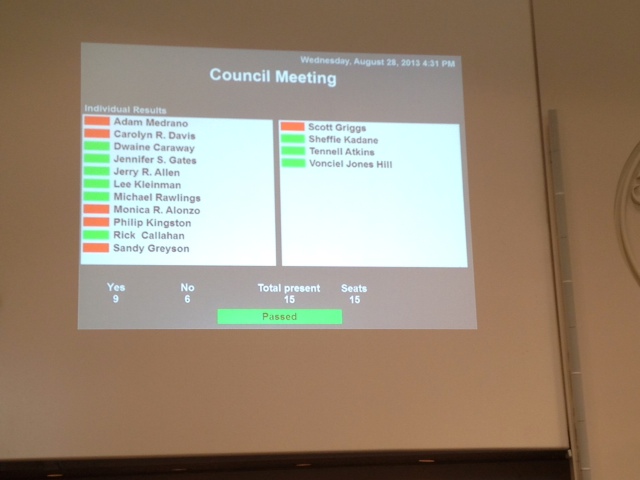
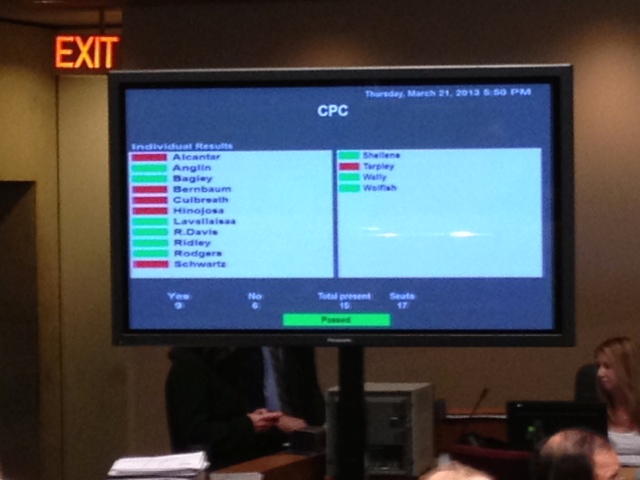
Who’s responsible for this statutory, contractual, constitutional and moral failure? Here are the votes by council and plan commission members. Ask them why they voted against. Note: The council measure didn’t “pass”. A three fourth’s vote was required because it failed at the CPC.

In the name of good government, hope it didn’t happen this way: Intimidated by the few but animated anti-fracking troglodytes (mentioned previously in this blog and other places) the commission and council members followed the politically expedient course: Deny the permits, thereby escaping the proximate wrath of the anti’s.  When the repercussions come home to roost, hope the fallout will be dispersed and the voters won’t notice. 

Here, revealed to me by insiders at city hall, is the trial strategy of the City and its lawyers.

Co-author Ann Weissmann

The Dietz family sued several lessees for injunctive relief and restorative damages arising out of leases on two non-contiguous tracts in Acadia Parish. In Dietz, et al. v. Superior Oil Company, et al  the trial court granted the lessees’ dilatory exceptions of prematurity and improper cumulation and dismissed the plaintiff’s suit without prejudice.

The family asserted that the lessees improperly used and abandoned oil field waste storage pits and exploration and production equipment, causing contamination of the soil and groundwater. The defendants filed the exceptions to avoid the suit.

Prematurity 

The defendants’ dilatory exception of prematurity asserted that they were not given notice prior to the suit as required by Mineral Code Article 136 and that the claims were premature, as the lease was still in effect.

The trial court’s grant of the prematurity exception was because the defendants had not been given written notice as required by Article 136. The appellate court found that the trial court erred in granting the prematurity exception. Claims for restoration of contamination are not governed by Mineral Code Article 136 and do not require advanced written notice as these claims “are separate and distinct from any claims that defendants failed to develop and operate the property”.

A suit for contamination of soil and groundwater may be brought before the lease expires. The lessee has obligations set out in the Mineral Code and in Civil Code Articles 2683, 2686, 2687 and 2692. Civil Code Article 2683 specifically defines the Lessee’s obligations. While Article 2683 has obligations which arise at the end of the lease, there is “absolutely no language to suggest that the other obligations imposed by these codal provisions are not operational until termination of the lease.”

Improper Cumulation

The trial court’s grant of the exception of improper cumulation was because there was a lack of community of interest between the joined parties. These exceptions were affirmed. In order to determine if there is a community of interest between the parties, the courts will look to see if the causes of action arise from the same facts and present the same legal and factual issues. Is there an overlap “present between the cases to make it commonsensical to litigate them together”? Proof of damages and liability would be different for each party. There were numerous defendants and non-contiguous lands, with each defendant having different lease obligations with different facts being proven for each operator. Therefore, there would be a lack of overlap required for a proper cumulation. The court affirmed dismissal of the suit without prejudice.

Driven to know the elements of improper cumulation? See Code of Civil Procedure Article 463.

Takeaways

I see two: 

The plaintiff-landowners lost this round but lived to fight another day.

The is no end soon to pollution claims against legacy producers in Louisiana oil fields.

In a case from Acadia Parish, how can we not pay musical tribute to J. D. Miller’s recording studio in Crowley.  Here is an example. 

The first step in successfully challenging the Keystone Pipeline: Choose a court that has jurisdiction. Mr. Bishop learned that lesson the hard way in Bishop v. TransCanada Keystone Pipeline.

Mr. Bishop lived in Nacogdoches County, Texas, when TransCanada attempted to negotiate an easement and pipeline right-of-way. Those negotiations failed and TransCanada brought a condemnation proceeding. Bishop believed TransCanada didn’t have the right of eminent domain and didn’t agree with the special commissioners assigned to the project (the process for Texas condemnation proceedings that aren’t resolved by agreement). The parties settled and executed a mediated settlement agreement.

Mr. Bishop wasn’t happy with the document, and as a pro se plaintiff (that is, without a lawyer to speak for him), filed a new suit in the County Court at Law of Nacogdoches County. He alleged in his petition that the agreements were as a result of coercion, duress and fraud. The question for the court was whether the dispute was over the ownership of land or over a breach of a contract. The significance is that as a statutory county court, the County Court at Law of Nacogdoches County does not have jurisdiction over “a suit for recovery of land.”

The real question was whether an easement involves an interest in land. In his petition Bishop requested that the court prohibit TransCanada from exercising its rights under the easement negotiated at the settlement and to rescind the easement and pipeline rights-of-way. The appellate court concluded that an easement is an interest in land and that the county court at law had no jurisdiction.  Mr. Bishop’s claims were dismissed.

Takeaway

If you are making a trip to the courthouse, bring along a lawyer.

Schizophrenia : A mental disorder characterized by a breakdown of thought processes and by impaired emotional responses. Common symptoms include delusions, such as paranoid beliefs; hallucinations and disorganized thinking.

Somebody is crazy, or at least very, very wrong, about the hydraulic fracturing debate.

Earthquakes and Fracking

In the controversy over “frackquakes”, brave small-town citizens are standing up to the rapacious oil drillers and their regulatory co-conspirators. Or, a outsiders are stirring up the locals and meddling in matters not of their concern.

Ecowatch sees it this way: Texans’ opinions about fracking are changing. The damage from “frackquakes” is “considerable”, including a 5.7 magnitude frackquake near Prague, Oklahoma. This turns fracking into a property rights issue and communities, even in Texas, have had enough. About 1,000 “concerned citizens” packed a public meeting about frackquakes near Azle. There was an “uproar” when the Railroad Commissioner holding the meeting announced a study of the issue but refused to answer questions. The leaders of the opposition are pleased that the local protestors are mad.

Meagan Baker in Energy in Depth sees it differently: “Fear and misinformation” are used to link fracking and earthquakes. Leading the protestors in Azle are national organizations such as Earthworks and Downwinders at Risk, funded by out-of-state “big money foundations”.  An essay by Cliff Frolich of the University of Texas Institute for Geophysics noted a correlation between injection wells and small quakes that are not harmful. A study by the National Research Council concluded that only a small fraction of injection and extraction activities have induced seismicity at levels noticeable to the public. These findings are similar to studies by the US Geological Survey, US Department of the Interior, and state geologists from Oklahoma and Colorado.

Water Use and Fracking

USA Today reports that in a recent study Ceres says the overuse of freshwater in fracking operations is a terrible threat to water-starved regions of the United States. Fifty-five percent of wells requiring hydraulic fracturing are in drought-stricken areas and half are in regions under “high or extremely high water stress”. The focus of the article is that the use of fresh water in fracking diminishes the availability for other uses. 

Triple Pundit  adds to the alarm by quoting huge volumes for use in fracking but none for other, more intensive, uses. (Where is the context?)   

Here is the entire Ceres report

In Forbes, David Blackmon questions Ceres’ point of view and impugns their motives. The report focuses on the threat on water sources imposed by fracking, without casting similar aspersions on other sources of water use.

Energy in Depth piles on, attacking Ceres as failing to take into account the effect onthe environment of  water use by chemical, mining, electric power, agriculture, food and beverage, textiles, semi-conductors and construction materials industries. Example: The amount of water used by fracking amounts to 1.3 percent of the amount used in carwashes.

So Who’s Crazy?

If you believe science trumps emotion and alarmism in these matters, you gotta figure the anti’s are the crazies. or are they, if their audience isn’t paying attentionto the details?  

It was 50 years ago this month that the Beatles first arrived in America, in a revolution as big as fracking. Not convinced? Compare the 1963 Beatles to the number 1 hit of  1962.

Co-author Ann Weissmann

If the significance of a lawsuit can be gauged by the 23 lawyers and 10 firms identified in the opinion, Olympia Minerals, LLC, et al v. HS Resources, Inc., et al., is as noteworthy as Bush v. Gore, Brown v. Board of Education, and even Kramer v. Kramer.

The Contract

The Olympia entities were the property owner and working interest owner of land in Calcasieu and Beauregard Parishes. Under the “North Starks Project Agreement”, HSR and Aspect Resources were to conduct a 3-D seismic survey of 135 square miles of land and to lease a minimum of 15% of the land. In exchange, HSR and Aspect received a 12-month non-exclusive geophysical permit covering all interests and a 12-month exclusive option to sublease the land.

The NSPA said: 

  • “HSR and Aspect shall lease a minimum of 15% of the EPMI Lands subject to the exclusive option, and shall work jointly with EPMI (the original contracting party) to prioritize the … Lands that may be subject to prescription and actively manage the exploration program to maximize … preservation of its mineral interests.”
  • “HSR and Aspect shall notify EPMI prior to commencement of the survey of the final shoot outline and shall furnish a copy of the pre-plot to EPMI. HSR and Aspect shall not be obligated to include all … lands optioned hereunder in the final survey outline.”
  • “HSR and Aspect shall provide to EPMI a copy of the 3-D seismic data across the Lands…the seismic data furnished to EPMI shall include field and support data”.

The Facts

Aspect completed a 3-D seismic survey of the south half of the land and delivered the results to EPMI, which were later delivered it to Olympia. Olympia then realized that the field data had not been delivered. This information was important to Olympia. HSR and Aspect also failed to lease at least 15% of the land.

The Questions for the Court

  • Did Aspect have an obligation or an option to lease 15% of the mineral interest?
  • Did Aspect have a duty to conduct a seismic survey over all the lands?
  • Was Aspect required to deliver all seismic data, including the field data, to Olympic?

Olympia sued HSR and Aspect , alleging breach of the agreement and sought dissolution, damages and specific performance of the portion of the contract requiring aspect to turn over all of the field data.

The Result

Aspect failed to perform all three of the major obligations in the NSPA within the 12 month period and breached the contract. The contract was not an option, but instead an obligation, to lease the 15% minimum.

The court relied on La. Civil Code Articles 2049 and 2050 requring interruption of contractual provisions so as to give each the meaning suggested by the contract as a whole. To give meaning to “HSR and Aspect shall not be obligated to include all EPMI Lands optioned…” would negate the survey obligation altogether. Therefore, Aspect breached its obligation to conduct a seismic survey over all the land.

The appellate court upheld trial court findings that HSR and Aspect breached the requirement that field data be made available to Olympia and exacerbated the breach by failing to provide the data upon request. The court ordered specific performance of Aspect’s obligation to deliver the field data and associated records and awarded $1,101,875 in lost bonuses and rentals. An award of $7,000,000 in lost royalties was deemed to be speculative.

A Factor

Apparently important to the court’s ruling was HSR and Aspect’s “conscious and calculated business decisions” to breach the contact and their “blatant refusal to perform that obligation  … “.

A case from southwest Louisiana crys out for some John Delfaose.

If you examine titles or read title opinions, this post is for you.

By Taylor Grove Lamb

 I was recently examining instruments for an East Texas title opinion when I came across an instrument that, at first glance, appeared to be an easement. Scanning the document, I saw the phrases “right of way” and “road”—leading one to believe this was a simple conveyance of a right of way. However, upon closer inspection, the instrument quit-claimed a “strip of land” totaling one and three-tenths acres, “[t]he same being the additional right of way necessary for the revision and betterment of the Marshall Jefferson road.”

 According to longstanding Texas Supreme Court law, “a deed which in the granting clause grants, sells and conveys a tract or strip of land conveys the title in fee, even though in a subsequent clause or paragraph of the deed the land conveyed is referred to as a right of way.” Texas Electric Ry. Co. et al v. Neale et al., 252 S.W.2d 451, 453 (Tex. 1952) [emphasis added].

Even though this instrument identifies the property as a “right of way”, the granting clause conveys “a tract”—this tiny distinction, the placement of two words, results in the conveyance of fee simple interest. Simply put, “[s]ubsequent recitals in an instrument as to use do not operate to limit the grant to a mere easement, if the granting clause conveys the land itself or the fee title thereto…” Texas Practice Series: Land Titles and Title Examination, §18.21 (Third Ed.).

Takeaway 

Examiners: Always be careful to not get caught up in the title of an instrument.  Read through the entire text and do not be tricked or misled by the phrase “right of way” if the granting clause identifies the interest conveyed as a “strip” or “tract”, especially in Texas.

There you have it. This calls for a musical interlude.

Coming soon: How is this issue treated in Montana and North Dakota?

With apologies for being absent for a week, I ask you to ponder this question when you embark on a fight with the officers and directors of the energy company you own a part of:  How does your subjective fear of harm factor into your right to injunctive relief? Not much, according to a Texas court in Schmidt, L.P., L.L.C. v. Richardson.

Disgruntled shareholders of Sun River Energy, Inc. feared that certain officers and directors, having issued themselves notes secured by mortgages on minerals owned by the corporation, and having not been paid, would foreclose on the properties, thereby depriving the remaining shareholders of their value in the corporation. The notes were for unpaid salaries, and the allegation was that the notes and mortgages were a scheme to fraudulently transfer the company’s assets to those certain officers and directors.

The plaintiffs obtained an injunction in the trial court. The court of appeals reversed on the basis that the threat of irreparable harm that a plaintiff must prove for a injunctive relief must be imminent.

At issue was a provision typical in many mortgages: If the mortgagee “deems … himself insecure and in good faith believes that the prospect of payment . . . is impaired . . .” he may foreclose. According to the court, because the six month period for repayment of the notes had long past, the remedy for insecurity resulting from a good faith belief in the “prospect” for payment was no longer relevant. By that language, the mortgages could not at the moment of the appeal create an “imminent” threat of injury. The language did not apply to the parties’ current situation. 

The court relied on a Texas Supreme Court opinion that “fear or apprehension of the possibility of injury” is different from actual injury. Fear and apprehension would not support injunctive relief and does not establish imminent harm. The basis must be more objective.

A factor that likely influenced the court was the defendants’ statements that they had not decided whether or not they would foreclose on the notes. One wonders if the court believed that the defendants would be crazy to foreclose after that statement under oath and incur the wrath of the trial court who, you will remember, granted the injunction in the first place.

Takeaway

What you have here is shareholders not playing well together. This reminds me of the aphorism: Your company agreements and other contractual obligations are no better than the character of the people with whom you are dealing. No disparagement of either side is intended: In this case, as in many, you can’t tell who are the good guys and who aren’t.

Lawyer Practice Tip

Lawyers for the plaintiff: If your injunction order doesn’t say the threat is “imminent”, you will lose in this court of appeal.